- All Posts
- blogs

Modern Slavery and Global Warming – By Honerable Amir Ohadi Modern Slavery and Global Warming — Why Transparent Supply Chains...

Human Trafficking – Multifaith Zoom event 29 November 2025 A COAT OF MANY COLOURS In Thomas Hardy’s novel The Mayor...

A comprehensive approach to combating Modern Slavery: the next steps Speech by Keith Best to webinar 29 November 2025 In...

Speach from Ms Nila Bala

Blessings to all who participated in the webinar 2025. Dear Respected Speakers and Participants, Your presence, your dedication, and your...

My name is Elsa, and I’m honored to serve as the Portuguese ambassador for Stop Human Trafficking Worldwide. Before I...

Good evening everyone. Today, I want to talk about a crucial but often overlooked link in the chain of human...
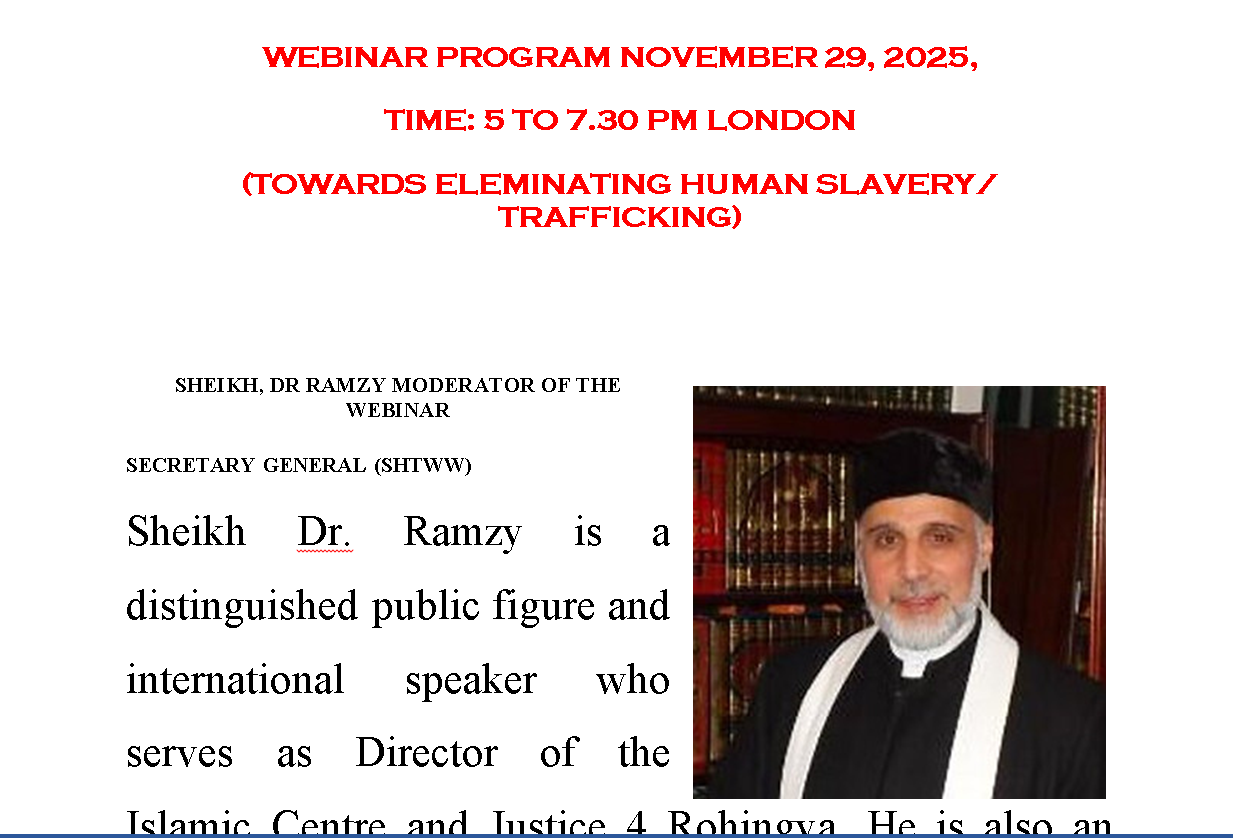
Programs-Speakers-Biography & Title of their speach

Speaker: Honorable Vincenzo Forino – Ambassador Stop Human Trafficking Worldwide Oxford November 29, 2025 In the name of God, the...

 Eelam Tamil Women & Youth: Human Trafficking and Vulnerability in the Global South – Awareness and Action
Author: Balananthini Balasubramaniam (Stop human trafficking CIC Peace Ambassador )
1. Introduction
The Global South hosts multiple communities whose structural vulnerabilities make them highly susceptible to human trafficking, exploitation, and criminal network manipulation. The Eelam Tamil community in Sri Lanka exemplifies conflict-induced vulnerability, while other countries face environmental, economic, or political triggers.
This article explores Eelam Tamils as a case study, situating the discussion within the broader Global South context, highlighting patterns of exploitation, structural drivers, and the urgent need for awareness campaigns.
2. Eelam Tamil Community: Conflict-Induced Vulnerability
2.1 Historical Background
Sri Lanka’s protracted civil war displaced thousands of Eelam Tamils, disrupted livelihoods, and weakened social protection systems (De Silva, 2010; Human Rights Watch, 2009). In this context, human trafficking has sometimes been mistakenly perceived as a necessary survival mechanism, especially by women and youth facing economic or security crises (IOM, 2020).
Reality: Human trafficking is a meticulously organised criminal enterprise exploiting vulnerabilities; it is not a form of protection (UNODC, 2021).
2.2 Gendered Impact
Women are disproportionately affected:
Sexual exploitation and abuse (ECPAT, 2018)
Forced labour without pay (ILO, 2020)
Forced religious conversion (Amnesty International, 2021)
Psychological trauma and social ostracism (Somasundaram, 2010)
Many victims have no access to legal remedies or protection, remaining trapped in cycles of abuse.
2.3 Youth Vulnerability
Youth are recruited not only as victims but as instruments for criminal activity:
Illegal employment and forced labour (ILO, 2020)
Involvement in drug or arms trafficking (UNODC, 2021)
Recruitment into extremist networks (Sivanandan, 2012)
Indebtedness and potential self-harm (Fernando, 2016)
Recruitment Tactics: Euphemisms such as “job opportunity,” “travel experience,” or ideological affiliations mislead youth into trafficking networks.
2.4 Misuse of Tamil Nationalism
Traffickers often exploit the guise of Tamil nationalism, presenting themselves as:
Social activists
Legal facilitators
Tamil nationalist advocates
This creates a false sense of security and deters suspicion, making awareness within the community crucial (Balasubramaniam, 2025).
3. Real-Life Case Studies
3.1 Trichy Drug Seizures (2023–2025)
September 2023: 12.86 kg of methamphetamine seized; arrests made (Times of India, 2023)
April 2025: Two individuals arrested for smuggling ~4 kg of ganja (Times of India, 2025)
January 2026: Three arrested for distributing narcotic tablets (Dinamani, 2026)
These cases demonstrate how drug trafficking intersects with vulnerable youth, often exploiting the same populations at risk of human trafficking.
3.2 Lakshadweep Maritime Interception (2025)
November 2025: Sri Lankan fishing vessel intercepted with 300 kg heroin, AK-56 rifles, and ammunition (New Indian Express, 2025; PIB, 2025).
Illustrates the connection between trafficking, narcotics, and arms smuggling in regional criminal networks.
4. Comparative Global South Perspective
While the Eelam Tamil community exemplifies conflict-driven vulnerability, other communities across the Global South experience different structural pressures, which nonetheless lead to similar patterns of exploitation, trafficking, and social marginalisation. Understanding these parallels allows for broader awareness and intervention strategies.
4.1 Eelam Tamils (Sri Lanka)
Primary Vulnerability: Protracted civil conflict, forced displacement, and economic deprivation.
Key Risk Factors: Loss of livelihoods, disrupted education, weakened social networks, post-war trauma.
Nature of Exploitation: Organised human trafficking, sexual exploitation, recruitment into criminal networks, and exposure to drug and arms smuggling.
4.2 Bangladesh
Primary Vulnerability: Environmental disasters such as flooding, cyclones, and river erosion.
Key Risk Factors: Displacement, poverty, loss of housing and livelihoods.
Nature of Exploitation: Child labour, unsafe migration, trafficking during displacement, exploitation in informal labour sectors.
4.3 Maldives
Primary Vulnerability: Geographic isolation, low-lying islands, and environmental threats (sea-level rise, extreme weather).
Key Risk Factors: Economic marginalisation, internal migration, limited access to employment.
Nature of Exploitation: Labour exploitation (especially domestic and tourism-related), inter-island trafficking, and coerced migration.
4.4 Other Vulnerable Global South Communities
Primary Vulnerability: Political instability, conflict, and economic crises in Africa, Southeast Asia, and South America.
Key Risk Factors: Forced migration, poverty, disruption of social and educational systems.
Nature of Exploitation: Human trafficking, forced labour, sexual exploitation, and recruitment into illicit networks.
4.5 Key Comparative Insight
Despite differences in the source of vulnerability — conflict, environmental disaster, or political instability — the mechanisms of exploitation are strikingly similar across these communities:
Women and children remain disproportionately affected.
Youth are often lured with promises of work, travel, or educational opportunities.
Exploitative networks adapt to local contexts but rely on structural weakness and social marginalisation.
Implication for Awareness:
Awareness campaigns, protective strategies, and community-based interventions can be adapted across regions, even if the triggering factor differs.
Real-world case studies, like human trafficking linked to drugs and arms smuggling in Sri Lanka and India, provide practical lessons applicable to other Global South contexts.
5. Structural Drivers of Trafficking
Across vulnerable communities, trafficking thrives where structural weaknesses exist:
Displacement and migration
Economic deprivation and unemployment
Educational disruption
Erosion of social and protective networks
Criminal networks exploit these vulnerabilities for maximum control and profit (UNODC, 2021).
6. Awareness and Protective Measures
Awareness is the first line of defence:
Do not uncritically trust terms such as “visa,” “job,” or “assistance” (UNODC, 2021)
Never travel without written agreements and verified documentation (IOM, 2020)
Familiarise yourself with legitimate legal and support mechanisms
Share plans with family or trusted community members
Identify and report suspicious actors
Principle: Silence or ignorance does not confer safety; informed vigilance is essential.
7. Conclusion
The Eelam Tamil case serves as a microcosm of broader Global South vulnerabilities, showing how structural, economic, and social pressures can be exploited by traffickers.
Key Takeaways:
Vulnerabilities differ by context (conflict, environment, political instability) but lead to similar patterns of exploitation.
Awareness, vigilance, and community engagement are universally critical.
Authentic protection of women, children, and youth is the true measure of community strength and resilience, far beyond performative identities or symbolic nationalism.
References
Amnesty International (2021) Forced Conversion and Trafficking in Sri Lanka. London: Amnesty International Publications.
Balasubramaniam, B. (2025) Eelam Tamil Human Trafficking Awareness: Case Studies and Community Protection. London: Small Drops Research.
De Silva, K.M. (2010) A History of Sri Lanka. Colombo: Vijitha Yapa Publications.
Dinamani (2026) ‘Three held for distributing narcotic tablets in Tamil Nadu,’ Dinamani, 15 Jan.
ECPAT (2018) Global Study on Child Trafficking. Bangkok: ECPAT International.
Fernando, R. (2016) Youth and Vulnerability Post-War in Sri Lanka. Colombo: University Press.
Human Rights Watch (2009) Sri Lanka: Human Rights Abuses Amid Civil War. New York: HRW.
ILO (2020) Child and Forced Labour in South Asia. Geneva: International Labour Organisation.
Islam, A. & Winkel, J. (2017) ‘Climate Change and Social Vulnerability in Bangladesh,’ World Development, 92, pp. 1–15.
New Indian Express (2025) ‘Sri Lankan fishing boat intercepted with heroin and rifles off Lakshadweep,’ 12 Nov.
PIB (2025) ‘NIA reports on Lakshadweep seizure,’ Press Information Bureau, India, 15 Nov.
Sivanandan, A. (2012) Globalised Youth, Trafficking, and Conflict. London: Minority Rights Publications.
Somasundaram, D. (2010) Collective Trauma in Sri Lanka. Colombo: Centre for the Study of Trauma.
Times of India (2023) ‘Meth seizure in Tamil Nadu,’ 20 Sep.
Times of India (2025) ‘Ganja smuggling arrests in Tamil Nadu,’ 12 Apr.
UNODC (2021) Global Report on Trafficking in Persons. Vienna: United Nations Office on Drugs and Crime.